Did learning a language in high school fail you? You’re not alone.
In this guide, I’ll show you the different ways you can study. And (most importantly) I’ll show you how to get the most out of every single sentence. I hope you enjoy.
💁 If you like the guide, join my discord group. I’ll help you out personally and give you more resources that I’m working on: https://discord.gg/xb4rmMgKeN
The Missing Pieces
Most people only experience language learning in school. Sure, it gives you an environment where you can ask questions and actively engage in the language…
But most people find that they can’t speak the language even after years of studying.
Why is that?
Well, schools tend to focus on reading and writing – but there’s more to language than just that, right?
If you want the full picture, you have to learn ALL of the pillars of a language…
The Four Pillars of Language Learning
Listening, Reading, Writing, Speaking
If you miss any of the 4 pillars of a language, you’ll miss out on a huge chunk of the language.
(This is how people ace proficiency tests yet they’re still not able to speak)
- If you can’t listen, you can’t understand what’s being said.
- If you can’t read, you’ll be missing out on tons of useful content
- If you can’t write, you won’t be able to communicate with people online.
- If you can’t speak, well…you probably already know what that feels like.
They all play a part and if you slack in any of these you miss a vital piece to the language.
What Is NOT Studying?
Casually sitting back watching dramas with subtitles – Is NOT studying.
Running a constant stream of shows 24/7 in the background – Is NOT studying.
Watching a series (only once) with ZERO subtitles – Is also NOT studying.
Yes, even if you watch shows with zero subtitles, you might not be studying the language.
How does that work?
It all comes down to one thing…
Passive vs Active
Passive learning is when you sit back and take in the language.
For example, on your drive to work, you can put on a podcast in Japanese. You’re not actively studying the language, but this helps fill idle time in your day and allows you to immerse yourself in the language.
But immersion is not enough. It’s the same reason why there are tons of expats living abroad for years and still can’t speak the county’s language.
In order to learn any language, you need to be actively immersed.
Active learning is when you take action to engage in the language.
For example, if you’re reading a book: You write down notes, look up unknown words, and then review what you’ve learned.
These are all small things that engage you in the process. Reading is great, but if you’re not engaged you probably won’t learn anything new.
So how can you engage yourself in the language you’re learning?
💁 If you like the guide, join my discord group. I’ll help you out personally and give you more resources that I’m working on: https://discord.gg/xb4rmMgKeN
The Key To Languages
The most important part of language learning is Context.
As a simple example, I’ll teach you a word in Japanese. Apple: りんご (Ringo)
Unless you’ve studied the language before, you have 0 context and it might be hard to remember.
But what if I showed you a picture of an Apple for context?

りんご (Ringo)
Personal Note: I like my “Ringo” green rather than red 😀
It’s easier to remember right?
And this works with the content you choose to study.
Then if you add someone saying the word, it adds another layer.
To top it off, how about hearing that word being used in a sentence while watching a show…
In that case, you know the story and the characters so you can connect the new unknown word with what you already know.
Someone on-screen might say, “I want to eat a candy apple!”
“りんご飴が食べたい!” (“Ringo ame ga tabetai!”)

You might have never heard those words in your life. That’s okay, all we’re doing is connecting the dots. The bigger picture will come later.
And you can take this even further to practice speaking too.
But before I get too far into that, lets start from the beginning. I’ll show you the different kinds of practices you can start right now.
[Note: Don’t feel like you have to do all of this all of the time. If it starts to feel tedious, switch things up to keep it fresh. Let’s have fun learning languages.]
Learning In The Four Pillars
Listening
🔑 The key to good listening practice is to listen to Natural Dialogue.
I have to say something that might sound strange at first…
Avoid audio lessons that are “made” for learners.
I’m talking about those audio lessons that often come with textbooks…Or the where the speaker talks to you like you’re 4 years old.
Sure they’re good to help you get a good grasp of the basics, but they lose their value very quickly.
You know why?
Well, real people don’t speak like that.
Real people talk fast – they cut off words – they mix sounds.
This is why so many people are able to do well in classes, but when they’re put into real situations, they freeze.
The best content is content made for native speakers.
But what do you do if you don’t know any of the words?
How To Hone Your Ears To Understand The New Sounds
🔑 Pick content that you can listen to over and over again and not get tired of it.
Step 1. Play the clip (*)
Step 2. Pause. Write down the sounds you hear.
Step 3. (Play the clip as many times as needed until you can write down all the sounds).
Step 4. Repeat
( * Important: Watch with ZERO subtitles or captions. Explained Below)
This is NOT about writing.
This is NOT about being correct.
This is about honing your listening.
When you slow down – and you think deeply about each and every sound – you force your brain to become comfortable with recognizing the sounds .
So sit down, play one sentence at a time and listen to it deeply.
You don’t have to understand every word – just hear the sounds.
Play that clip as many times as you need until you can write down all of the sounds.
To top it off, compare what you wrote w/ what was actually said.
By comparing, you can see where you slipped up. Don’t feel bad about these mistakes.
Even if you hear all the wrong sounds, you make progress by forcing yourself to listen with intent.
(This is probably the best dedicated listening practice you can do.)
💁 If you like the guide, join my discord group. I’ll help you out personally and give you more resources that I’m working on: https://discord.gg/xb4rmMgKeN
Reading
Two Birds with One Stone
Leveling Up!
In this practice, you use the captions to your advantage.
First, you can simply watch the entire show again with the captions in your target language.
That alone is helpful because now you have context. You know the story, so you can focus on the language rather than figuring out what’s going on.
But what if you want to be more active in your learning, you can…
Save Sentences w/ Audio To Review Whenever You Want
Before I tell you exactly how to do this, there is one very important concept you should know…
What You Know +1
What do I mean by What You Know +1?
It means, if you take a sentence for review, you should know every word in that sentence + the 1 word you’re learning.
For example, let’s take this sentence:
I saw that man slip on a banana.
And contrast it with this sentence:
I witnessed that burly man slip after he stomped on a banana peel.
📝 What do these colors mean? I’ll explain in the next section.
This example is in English, but imagine if it was in the language you’re learning!
If learning slip was your focus, then the second sentence would make your brain fry before you even get to the word.
This is why you should know ALL other words in the sentence (AKA What You Know +1).
It helps you isolate one word and bring it into real context with words you already understand.
What Are Those Colors In The Example?
These colors are how we make sentences easy to read at Mezasu.com.
Every word has a highlighted color.
Blue are new words that you haven’t saved.
Newly saved words turn red then fade as you get to know them. When there’s zero highlight color, that means you know the word.
That makes it super easy to use What You Know +1, right?
But I want to show you something even better.
💁 If you like the guide, join my discord group. I’ll help you out personally and give you more resources that I’m working on: https://discord.gg/xb4rmMgKeN
Saving Audio Clips Anywhere Online
🔑 This will also be useful later with speaking practice.
While studying, you might find a phrase you want to review. There are ways to record audio clips, but we want to make it easy for you to record clips anywhere online and save them so they can review those clips in more ways than one.
[Note: The following features are still in production. I will share how it will be done on Mezasu.com, but you’re free to take the method and do it on your own.]
Our plug-in already allows users to save words from almost any website.
And currently we’re building out features where you can record any audio online with one button.
[Note: All audio features will have free and premium versions.]
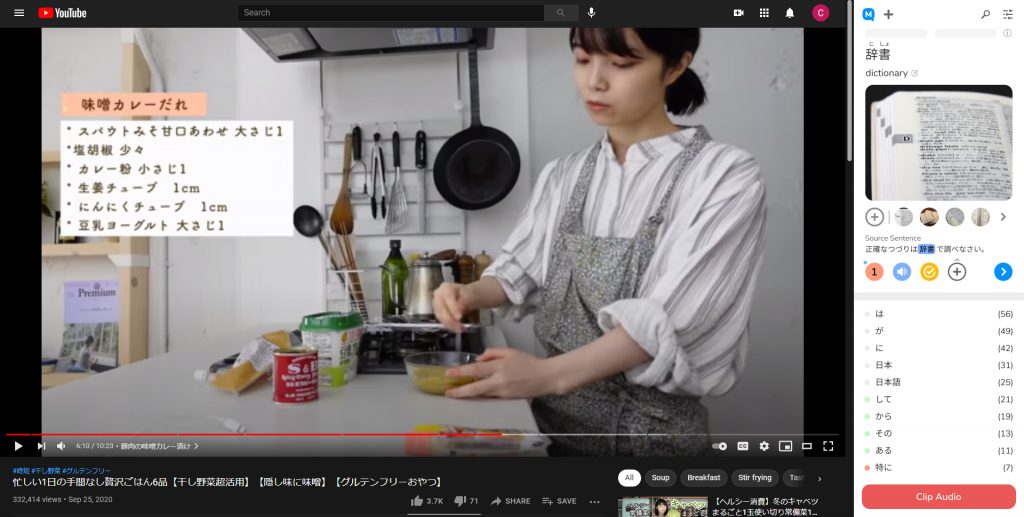
Once the audio has been recorded, you can edit it to the perfect length.
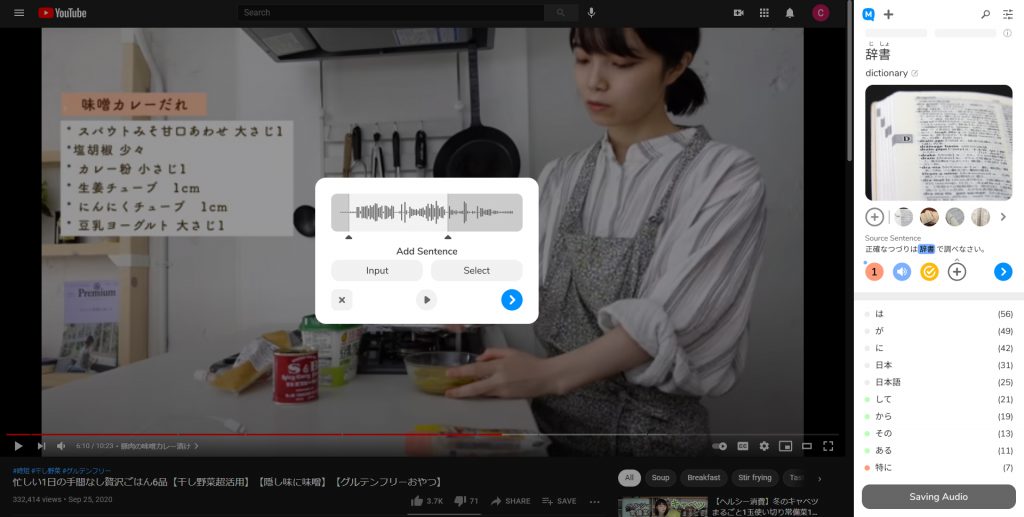
Plus, you can save the sentence along with the audio clip.
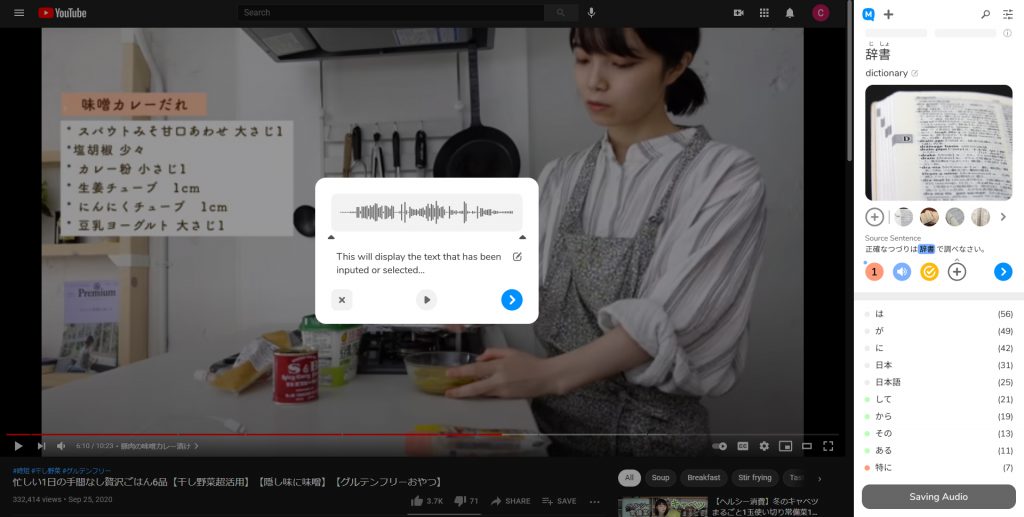
[Note: Again, the following features are still in production. If you want more information, you can ask within the Discord group]
💁 If you like the guide, join my discord group. I’ll help you out personally and give you more resources that I’m working on: https://discord.gg/xb4rmMgKeN
Superpowered Flashcards
Most flashcard apps simply dump a bunch of words on you. That’s no fun!
But what if you turn those cards into a multimedia review with real sentences from shows you enjoy?
Now that’s what I call Superpowered Flashcards!
Writing
Your Hand Will Hurt After This – In A Good Way
Leveling Up Again!
This practice is simple: Listen, Read, Write
You listen to a sentence, you read text, then you copy it by hand word-by-word.
This is one of the most powerful methods you can do because it covers 3 out of the 4 major categories of language learning.
To be clear, I’m NOT talking about typing.
I’m talking about writing everything BY HAND.
Why Writing “By Hand” is Important
Writing by hand works a different part of your brain. It’s more dynamic than typing because you have to put pen-to-paper and write every stroke. It’s a slower process, but that slowness is exactly what makes this valuable.
This practice is also great for learning vocabulary and grammar.
Speaking
Speaking is a skill.
The only way to improve any skill is through practice. You have to spend time practicing speaking if you want to get better. But how do you do this alone?
Get Your Audio Clips To Go The Distance
After you’ve collected some audio clips, you can use them to practice speaking.
The practice is pretty easy and it only takes three steps.
- Listen to the audio clip
- Record yourself speaking that same clip
- Compare
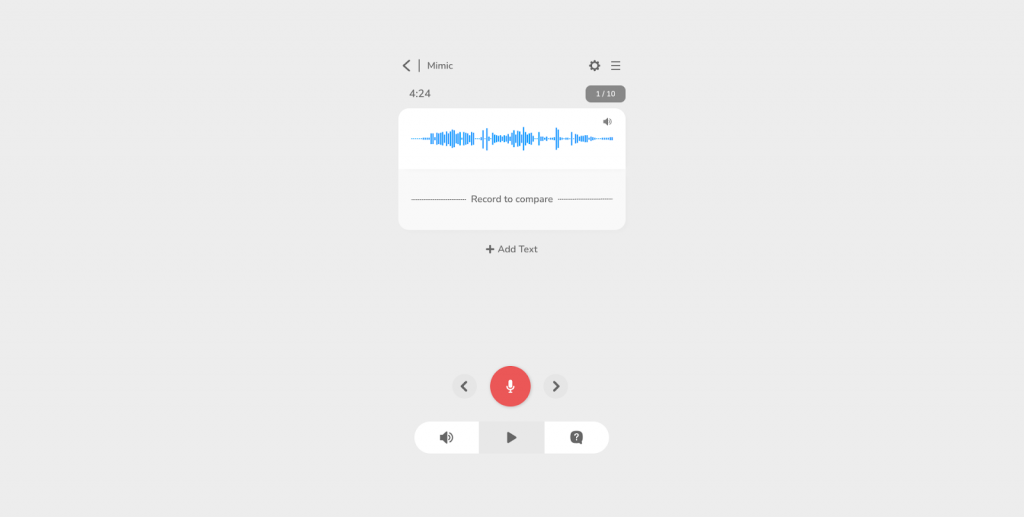
Simple, right?
But I’ll tell you, doing this simple practice can change your life.
It’s one thing to speak the language, but it’s another thing to hear yourself back.
Ohh MAN!!! Be warned…you might cringe when you first hear yourself speak!
That’s why this practice is so valuable. You can compare yourself with a native speaker almost instantly.
This is the best speaking practice to do when you’re alone – but of course, the don’t forget to get out and speak with real people.
Take A Peek Into The New World You’re Discovering
Language learning will be a long journey. So sometimes, you just need to sit back and have some fun.
How to Get a Motivation Boost After You Study
You can’t appreciate how far you’ve come if you never look back.
For me, when I was learning Japanese, one of the first shows I studied was “New Game!”
I spent hours, watching, rewatching, writing, listening, etc, etc. After a certain point in time, I became tunnel-visioned because I focused way too hard on the individual words and sentences.
That’s when I took a step back and watched the show again.
No studying and no subtitles.
WOW! I practically understood everything being said!
It was a magical experience.
There I was watching this show I couldn’t understand a month ago…but now I’m understanding it perfectly!
So never forget to look back at all the progress you made.
Stay motivated.
Ultimately, the only people who suck at language learning are the people who quit.
💁 If you like the guide, join my discord group. I’ll help you out personally and give you more resources that I’m working on: https://discord.gg/xb4rmMgKeN